

Categories: Spine Surgery Technology
Tags: 3D printed spinal implants smart spinal implants spine robotics and navigation
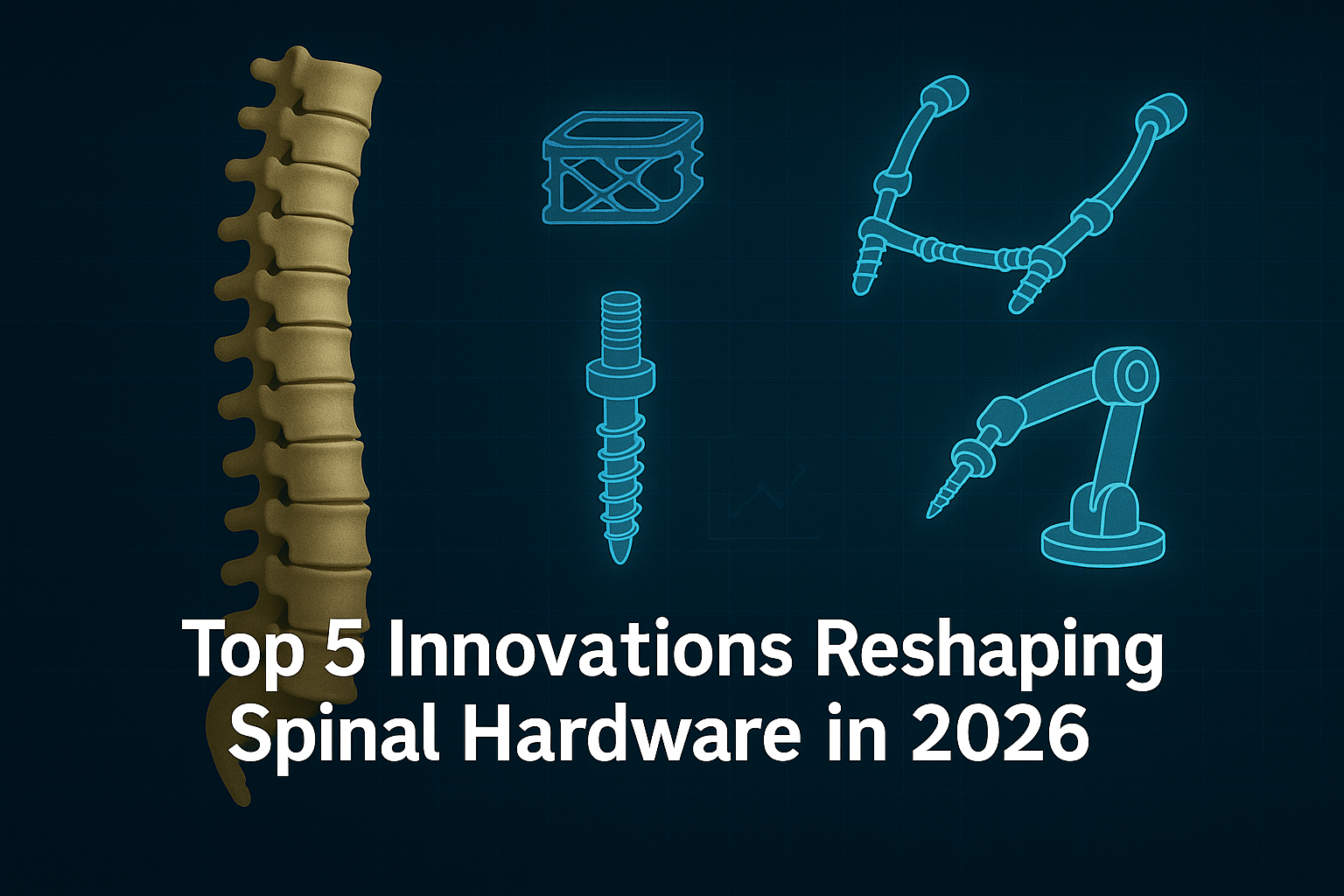
As we move into 2026, spinal hardware is being reshaped by a set of innovations that are already in clinical or pre-clinical use today. These advances span personalized implants, porous biomaterials, motion-preserving devices, precision placement technologies, and early “smart” implant systems.
Below are five innovations that are measurably changing how spinal hardware is designed, selected, and used in real patients.
Additive manufacturing (3D printing) has evolved from simple anatomical models to patient-specific spinal implants and instruments. Systematic reviews describe how 3D printing enables medical-grade implants with customized shapes, complex internal structures, and surface textures designed for bone integration. PubMed+1
Recent clinical reports show patient-specific interbody cages and vertebral body replacements being used at cervical, thoracic, and lumbar levels, as well as custom sacral prostheses and guides for pedicle screws and osteotomies. MDPI+2Journal of Spine Surgery+2
Key implications:
Improved anatomic fit in deformity, tumor, and revision cases.
Potential for better load sharing and alignment, especially where standard implants don’t match native anatomy.
More precise pre-operative planning using 3D models and custom jigs.
As these workflows mature, patient-specific hardware is moving from rare “one-off” cases into broader use for complex degenerative and deformity surgery.
Interbody cage design is shifting from solid PEEK or titanium blocks to porous, lattice-structured titanium implants engineered for both biology and mechanics.
Biomechanical and clinical studies report that porous titanium cages:
Provide increased surface area and architecture favorable for bone ingrowth and bridging. PubMed+1
Can mitigate subsidence compared with traditional designs, including PEEK cages, in lateral lumbar interbody fusion. ScienceDirect+2Frontiers+2
Recent work has also focused on systematically optimizing cage parameters (porosity, footprint, stiffness) to reduce subsidence in experimental bone models and animal fusion studies. PubMed+1
For surgeons, the practical impact is:
More options that balance endplate protection and stability.
Implants designed to behave more like cancellous bone in stiffness, potentially reducing stress shielding.
Beyond disc arthroplasty, posterior motion-preserving systems are now supported by emerging clinical data. The TOPS™ (Total Posterior Spine System) facet replacement device is one example, designed to provide stability after decompression while maintaining motion at the treated segment.
Prospective studies and follow-up analyses have reported:
Clinically meaningful improvements in pain and function at 1–2 years compared with fusion in selected patients. PMC+1
Feasibility and maintained benefit at mid-term follow-up for facet replacement. ScienceDirect+1
These systems are not universal substitutes for fusion, but they represent a real, evidence-based option in carefully selected cases where motion preservation may reduce adjacent segment stress.
Robotic and navigation-assisted pedicle screw placement has moved from early adoption into more routine use at many centers. Multiple randomized or controlled studies and meta-analyses show that:
Robotic or navigated pedicle screw techniques can achieve higher placement accuracy and lower rates of facet joint violation compared with freehand methods. PubMed+3PMC+3ScienceDirect+3
These systems integrate:
Pre- or intra-operative 3D imaging.
Real-time guidance to plan trajectories and execute them with millimeter-level precision.
In some centers, minimally invasive and endoscopic workflows guided by 3D navigation. The Times of India+1
For spinal hardware, this means:
More consistent screw placement and construct alignment.
Potential reduction in revision surgery related to malpositioned hardware.
Better ability to use complex constructs (e.g., long deformity cases) with confidence in trajectory accuracy.
“Smart” orthopedic implants—devices that incorporate sensors and wireless communication—have progressed from concept to early prototypes and pilot systems.
Reviews of “SMART” orthopedic implants describe devices designed to measure load, strain, and other parameters in real time, with spine identified as a key application area. PMC+1
Research groups in Europe have developed rod-mounted sensors that continuously measure forces across spinal fusion constructs, with the goal of tracking healing progress and detecting potential complications earlier. spine-biomechanics.balgrist.ch
In 2025, collaborations supported by NIH grants were announced to develop self-powered spinal implants capable of transmitting real-time data from inside the body. SPINEMarketGroup+3News-Medical+3news.engineering.pitt.edu+3
These innovations are still in the development and early-evaluation phase, not routine clinical tools. But they signal a plausible near-term future where spinal hardware can:
Provide objective signals of fusion progression or construct overload.
Help differentiate normal postoperative pain from early mechanical issues.
Generate anonymized performance data that feeds back into device design and patient counseling.
Taken together, these five trends point toward a spinal hardware ecosystem that is:
More personalized (patient-specific implants and pre-op planning).
More biologically and mechanically informed (porous and optimized cage designs).
More function-preserving where appropriate (motion-preserving posterior systems).
More precisely executed (robotic and navigated placement).
Increasingly data-aware (early smart implant and sensor concepts).
All of these developments are grounded in current trials, clinical experience, and biomechanical research as of 2024–2025. The reasonable expectation for 2026 is not the arrival of entirely new categories of hardware, but the wider clinical integration and refinement of these already-emerging technologies.