

Categories: Spine Surgery Technology
Tags: Artificial disc Lumbar disc replacement
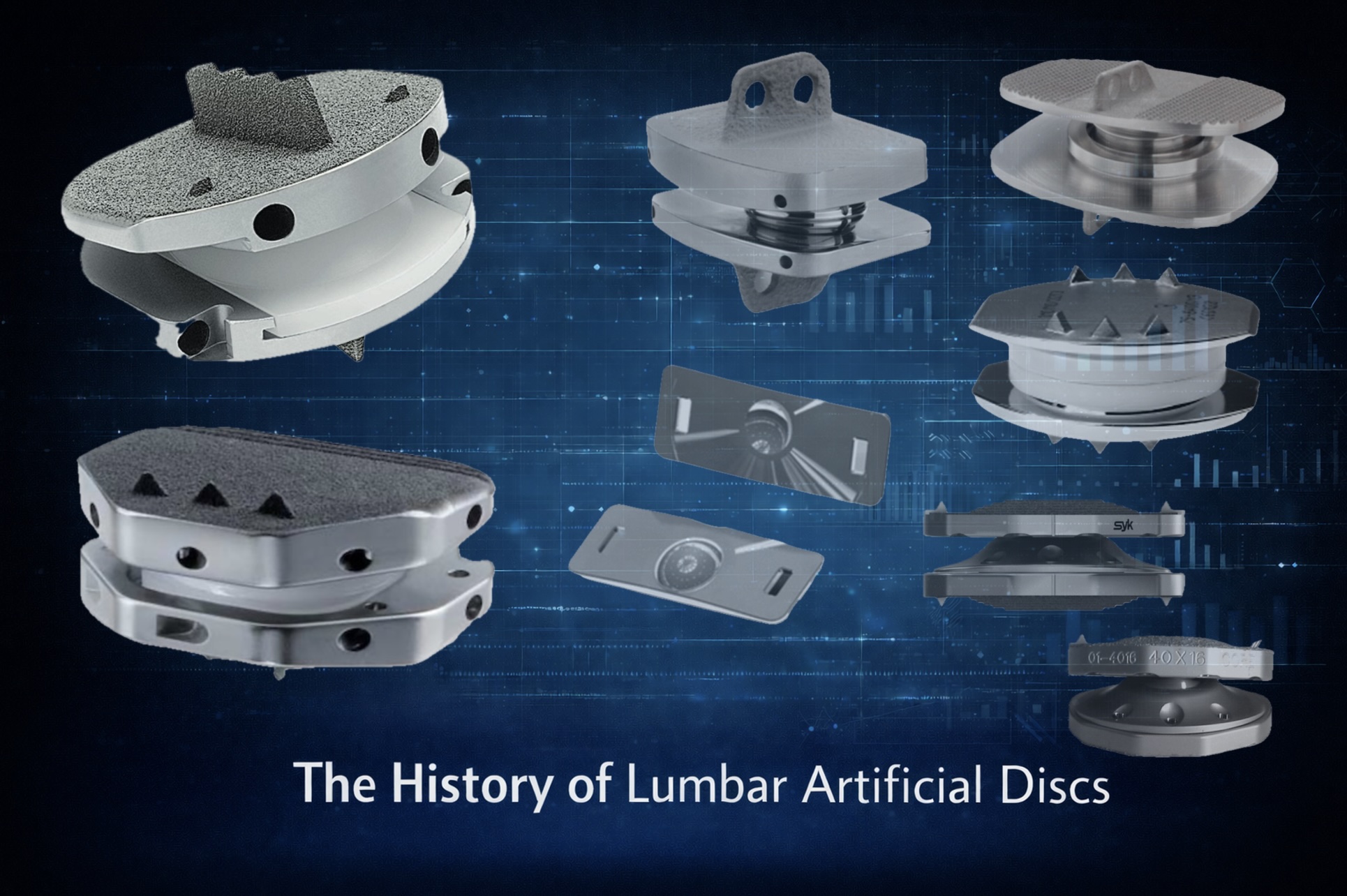
Lumbar artificial disc replacement has a history shaped as much by what failed as by what survived.
Several devices that once held promise have since been withdrawn from the market: FlexiCore, Kineflex lumbar, InMotion/XL-TDR, and Triumph, among others.
Their exit doesn’t necessarily mean they were unsafe. Instead, these devices were removed due to a combination of factors that became clear only after extended real-world use:
Importantly, many of these limitations emerged after regulatory approval—information that formal trials and marketing materials rarely capture.
This pattern underscores the critical role of post-market surveillance and surgeon-reported experience in understanding what actually works long-term.
Devices that have persisted in the lumbar ADR space tend to share certain design principles—not radical innovations, but refined lessons learned from earlier failures:
While no lumbar disc eliminates the need for careful patient selection, modern designs reflect an evolution informed by what didn’t work—not an ignorance of it.
A critical caveat: No conclusive clinical evidence exists demonstrating superiority of lumbar ADR over fusion across all patient populations. Outcomes remain highly dependent on indication, anatomy, and surgical execution.
More recent efforts represent a departure from rigid or semi-constrained articulations.
Viscoelastic lumbar discs, such as the Axiomed disc, aim to more closely replicate native disc biomechanics by incorporating compressibility and shock absorption.
Early clinical investigations suggest potential advantages in load sharing and motion quality. However, long-term comparative outcome data remain limited, and widespread adoption has not yet occurred.
As with earlier generations, these designs will ultimately be judged not by theoretical biomechanical advantages—but by durability, revision patterns, and reproducibility in routine practice.
External reference:
Phillips FM et al. Lumbar disc replacement: current status and future directions.
Journal of the American Academy of Orthopaedic Surgeons.
https://journals.lww.com/jaaos/Fulltext/2015/01000/Lumbar_Disc_Replacement__Current_Status_and.2.aspx
Lumbar artificial disc replacement has not failed as a concept—but neither has it achieved universal adoption.
Its evolution underscores a recurring truth in spine surgery: devices succeed or fail over time, not at launch.
Without structured mechanisms to preserve historical device performance, surgeons evaluating new lumbar ADR technologies risk:
By allowing side-by-side review of current and discontinued lumbar discs, NeuroSpine Product Review aims to retain this longitudinal perspective—capturing lessons that would otherwise disappear.
Formal trials establish safety and initial efficacy. But they rarely capture:
These insights accumulate slowly and are often shared informally—at conferences, in the lounge, case by case.
Structured surgeon-reported review systems offer an opportunity to preserve that experience in a way that benefits both clinicians and device developers.
The history of lumbar artificial disc replacement is defined as much by attrition as by innovation.
Devices that no longer exist remain clinically relevant—because they shaped the principles underlying those still in use, and those yet to come.
Understanding lumbar ADR requires more than knowledge of current products. It requires familiarity with the lineage that preceded them.
Preserving that history is essential for informed adoption, responsible innovation, and improved long-term outcomes.