

Categories: Medical Device Evaluation Spine Surgery Technology
Click Here to see all available Zero-Profile Stand-Alone ACDF Spacers
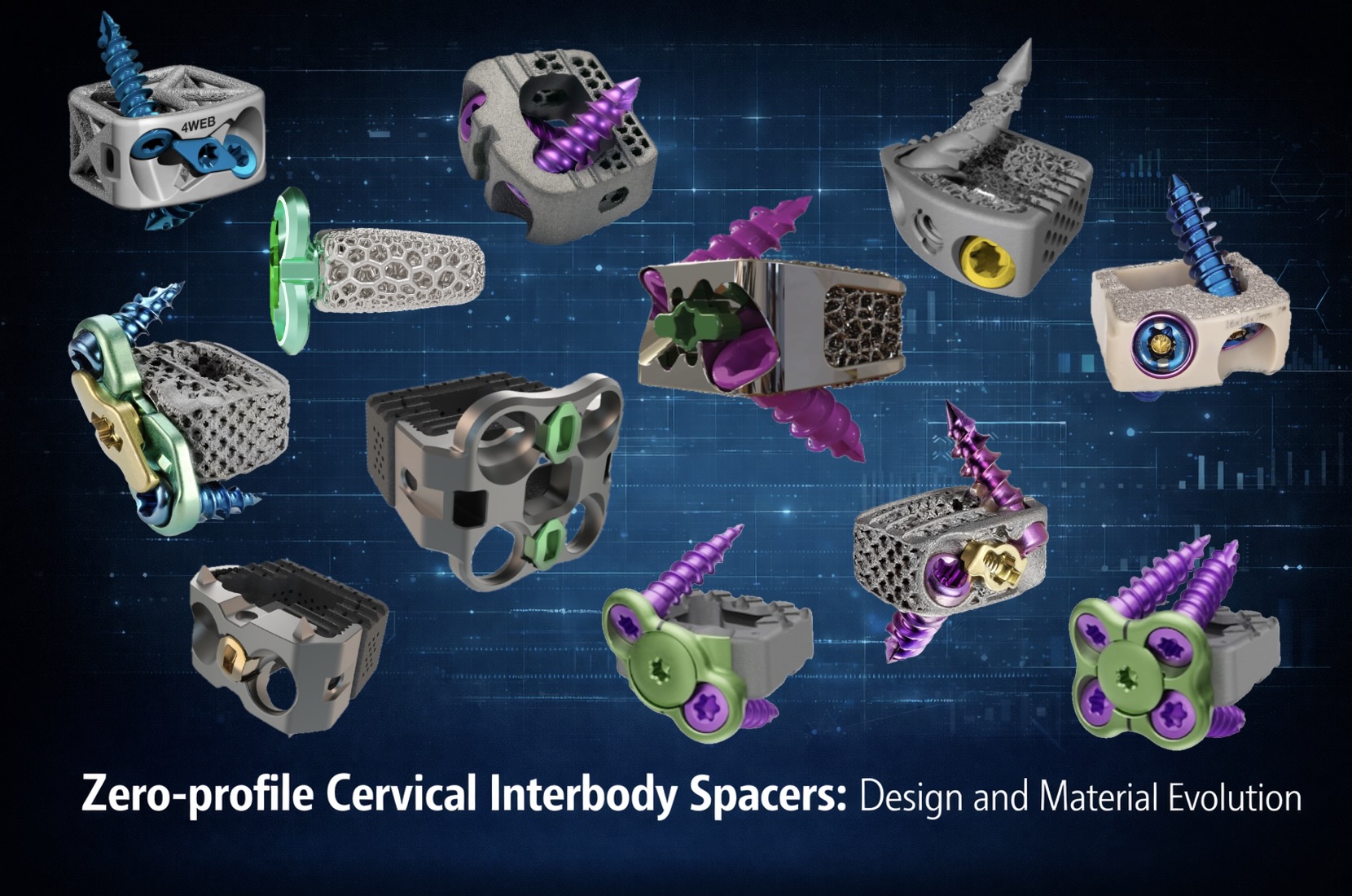
Anterior cervical discectomy and fusion has undergone repeated design cycles, but few shifts have been as practice-changing as the move toward zero-profile cervical interbody spacers with integrated fixation.
Unlike traditional cage-plus-plate constructs, these devices function as a single, low-profile implant with fixation integrated directly into the interbody spacer. The intent is straightforward: achieve immediate stability while minimizing anterior soft-tissue disruption and avoiding the profile of a separate cervical plate.
Recent generations reflect two parallel advances:
Together, these changes have renewed interest in zero-profile constructs across both single-level and select multilevel ACDF procedures.
Modern zero-profile spacers differ meaningfully from earlier iterations.
Key design characteristics:
Theoretical advantages:
While definitive long-term comparative data on adjacent segment disease remain heterogeneous, the design intent is to reduce biomechanical and anatomic disruption at adjacent levels—a principle that has driven continued adoption.
Surgeons often weigh several considerations:
Zero-profile spacers are most commonly used in single-level ACDF, though select surgeons extend their use based on pathology, bone quality, and alignment goals.
Importantly, these implants function mechanically as both interbody spacer and fixation device, blurring the traditional distinction between “cage” and “plate.”
One practical driver of interest has been coding.
In appropriately selected cases, integrated fixation devices may meet criteria for reporting CPT 22845 when the implant functions as anterior instrumentation rather than a standalone cage. However, this determination is payer- and documentation-dependent. Surgeons must ensure operative reports clearly describe the fixation component and its function.
This remains an area of variability in reimbursement and interpretation, reinforcing the need for careful documentation rather than assumptions based on implant branding alone.
Parallel to design changes has been a shift away from conventional smooth PEEK spacers.
Newer zero-profile devices increasingly incorporate advanced material strategies intended to improve osseointegration and fusion biology:
While each material strategy carries theoretical advantages, comparative long-term outcome data remain evolving, and real-world performance varies by design and execution.
Despite increasing sophistication in both design and materials, these implants are not interchangeable in practice.
Small differences in screw trajectory, fixation angle, endplate contact geometry, and surface architecture can meaningfully affect intraoperative handling and long-term behavior.
Much of this nuance is learned only after repeated use—experience that is rarely captured in published trials or marketing materials.
Zero-profile cervical spacers represent a convergence of biomechanics, materials science, and surgical technique. Understanding which designs perform well—and in which contexts—requires shared, structured surgeon experience.
That gap between design intent and clinical reality is precisely where post-market evaluation becomes most valuable.
Click Here to see all available Zero-Profile Stand-Alone ACDF Spacers